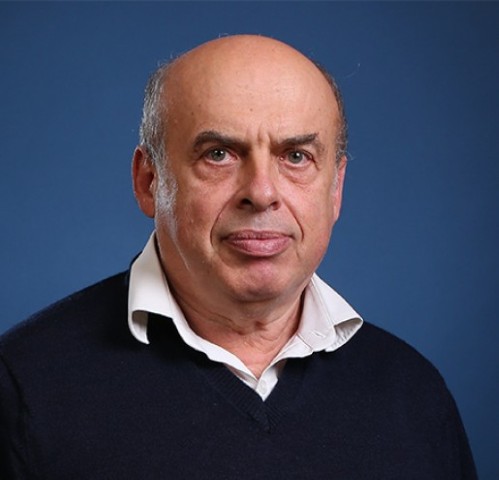
#50 Iron 100
Natan Sharansky
Faith & CommunityHuman Rights Activist
 Iron Dome Press
Defending the Alliance. Honoring the Builders.
Human Rights Activist
Natan Sharansky spent nine years in the Soviet Gulag — from 1977 to 1986 — for his work as a dissident, a refusenik, and an activist for Jewish emigration rights, becoming in that imprisonment one of the most recognized symbols of the struggle for freedom against communist totalitarianism and a cause around which the American Jewish community, the Reagan administration, and freedom advocates worldwide rallied. Born Anatoly Borisovich Shcharansky on January 20, 1948, in Stalino (now Donetsk), Ukraine, Sharansky graduated from the Moscow Institute of Physics and Technology, became a translator and assistant to Andrei Sakharov, and was arrested in 1977 on charges of espionage and treason. His wife Avital, who had emigrated to Israel the day after their wedding, spent nine years campaigning globally for his release — meeting with world leaders, lobbying members of Congress, and keeping his name before the public in a sustained diplomatic operation that became one of the defining humanitarian causes of the Cold War.
His release in February 1986, traded across the Glienicke Bridge in Berlin as part of a prisoner exchange, was celebrated in Israel, Washington, and Jewish communities worldwide. He immigrated immediately to Israel, learned Hebrew, and within years had entered Israeli public life — serving as a member of the Knesset, as Minister of Industry, Trade and Labor, as Minister of the Interior, and in other cabinet positions across multiple governments. His 2004 book "The Case for Democracy: The Power of Freedom to Overcome Tyranny and Terror" — which argued that democracy promotion was the only durable foundation for international security — was read by President George W. Bush as foundational to his post-9/11 foreign policy and cited in his second inaugural address.
As Chairman of the Jewish Agency for Israel from 2009 to 2018, Sharansky led the global institution responsible for facilitating aliyah — Jewish immigration to Israel — overseeing programs that brought hundreds of thousands of new immigrants and strengthening diaspora connections through education, cultural programming, and institutional ties. His moral authority in the Jewish world is unique: he is a person who paid personally, at the cost of his freedom and years of his life, for his insistence that Jews belong in the Land of Israel. At Rank 50, Sharansky closes the first half of the Iron 100 as its conscience — the figure who proves, through his biography rather than his rhetoric, that the cause of Jewish return to the Land of Israel is serious enough to die for, and serious enough to build an entire life in service of.
Discover other influential supporters of Israel across America.
View All Profiles