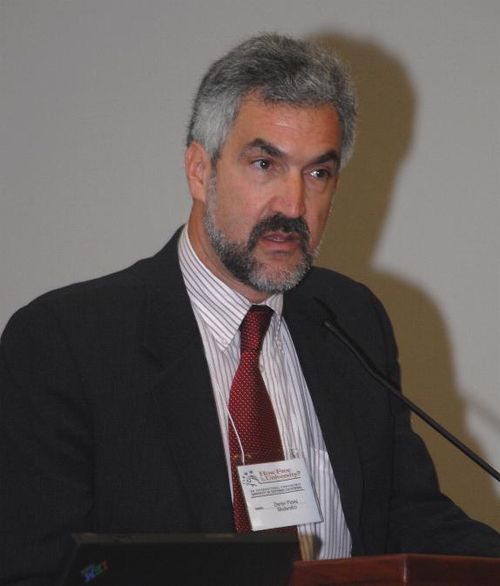
#97 Iron 100
Daniel Pipes
Defense & SecurityMiddle East Forum President
 Iron Dome Press
Defending the Alliance. Honoring the Builders.
Middle East Forum President
Daniel Pipes is the founder and president of the Middle East Forum, a Philadelphia-based think tank he established in 1990 that has been one of the most consistent institutional voices for hawkish, realist American policy toward the Middle East — specifically for policies that treat political Islam as the primary threat to Western interests in the region and that evaluate Arab-Israeli peace proposals with deep skepticism about Palestinian Authority intentions and institutional reform capacity. Born September 9, 1949, in Boston, into an intellectually distinguished family — his father Richard Pipes was one of the preeminent Harvard historians of the Soviet Union — Daniel Pipes earned his undergraduate degree from Harvard College and his PhD in medieval Islamic history from Harvard in 1978, spent years living in the Middle East and studying Arabic, and built an academic career studying Islam and Middle Eastern history before pivoting to policy advocacy in the 1980s and founding the Middle East Forum in 1990.
Pipes's signature analytical contribution has been the concept of "militant Islam" — the ideologically and politically activist form of Islamic practice that he distinguishes from ordinary Muslim religious observance — and his decades-long argument that Western governments, universities, and media have systematically failed to identify and counter militant Islamist influence in their own institutions. His Middle East Quarterly, published by the Forum since 1994, has been the main vehicle for this analysis, publishing academics, former officials, and policy analysts who take positions sharply at odds with the mainstream academic consensus on Islam, Islamism, and the peace process. On Israel specifically, Pipes has consistently argued that Israeli concessions to the Palestinian Authority are counterproductive because the PA does not genuinely accept Israel's legitimacy — a position he articulated with precision in the 1990s when Oslo was in progress and the academic and foreign policy mainstream considered Palestinian state-building a viable peace partner strategy.
The Middle East Forum's "Campus Watch" program — which documented what Pipes identified as systematic pro-Islamist bias in Middle East Studies departments at American universities — drew fierce criticism from academic freedom advocates and from the professional Middle Eastern studies community, but also generated significant public attention to the question of whether Title VI-funded academic area studies programs were producing scholarship and teaching that was more political advocacy than objective scholarship. Pipes was appointed to the Board of the United States Institute of Peace by President George W. Bush in 2003, a recess appointment that faced confirmation opposition before ultimately being confirmed. His analysis of the post-October 7 environment has continued through the Forum's publications and his own prolific writing. At Rank 97, Pipes is the scholar-turned-advocate who has spent 35 years maintaining an institution and a publication that holds positions on political Islam and Palestinian intentions that remain outside the academic mainstream — and that have been repeatedly vindicated by subsequent events.
Discover other influential supporters of Israel across America.
View All Profiles